When the United States entered World War 2 in December 1941, its tank force was small, outdated, and unprepared for the armored warfare sweeping across Europe and North Africa. Within four years, American industry had produced over 88,000 tanks — more than any other nation except the Soviet Union — fielding a diverse lineup of light, medium, and heavy armor that helped turn the tide on every front.
This complete guide covers every tank officially used by US forces in World War 2, including full specifications, combat history, strengths, weaknesses, and lasting legacy.
Related: Every Soviet and Russian Tank Since 1917
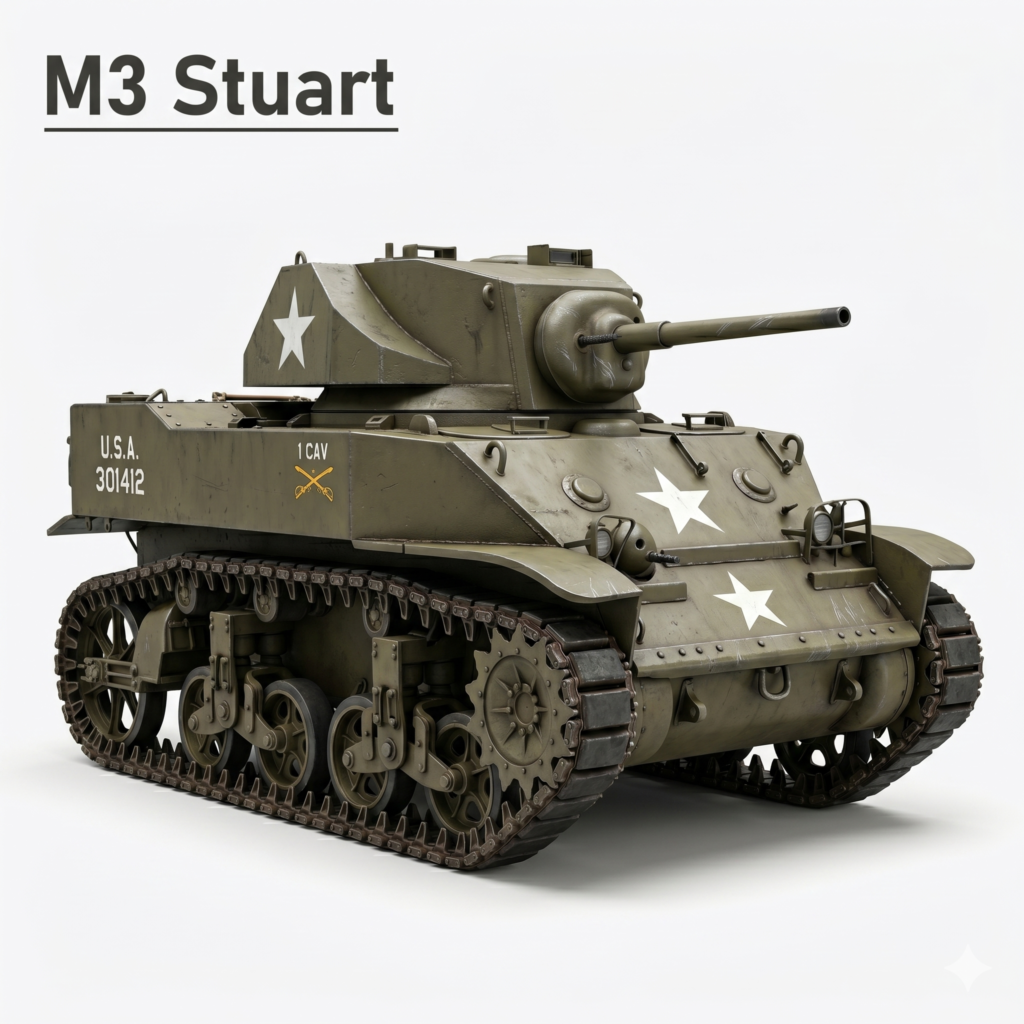
1# M3 Stuart — Light Tank
In Service: 1941–1945
Also Known As: “Honey” (by British crews)
Total Produced: 13,859
History and Development
The M3 Stuart was America’s primary light tank at the start of World War 2. Developed in the late 1930s as an evolution of the M2 light tank, it entered production in 1941 just in time to equip US and British forces as the war expanded globally.
British crews nicknamed it “Honey” for its reliability compared to their own under-performing tanks. It saw its first major combat in North Africa with British forces in November 1941 during Operation Crusader, where its speed impressed commanders but its light armor proved vulnerable to German anti-tank guns.
Combat History
The Stuart fought on virtually every front of World War 2. In the Pacific, it proved highly effective against Japanese forces who lacked heavy armor of their own. In North Africa and Europe, it was gradually phased out of tank-vs-tank roles and reassigned to reconnaissance duties, where its speed was an asset rather than a liability.
Filipino and American forces used Stuarts during the desperate defense of the Philippines in 1941–42. Later, Stuarts participated in every major US campaign from Tunisia to Germany.
Specifications
| Specification | Details |
|---|---|
| Weight | 14.7 tons |
| Length | 14 ft 10 in (4.54 m) |
| Width | 7 ft 4 in (2.24 m) |
| Height | 7 ft 6 in (2.29 m) |
| Crew | 4 |
| Main Gun | 37mm M6 gun |
| Secondary Armament | 3–5 × .30 cal Browning machine guns |
| Engine | Continental W-670 radial, 250 hp |
| Top Speed | 36 mph (58 km/h) |
| Range | 60 miles (97 km) on road |
| Armor (max) | 51 mm |
Strengths and Weaknesses
Strengths: Fast and reliable; mechanically simple; excellent for reconnaissance; effective against infantry and light vehicles.
Weaknesses: 37mm gun too small to defeat medium or heavy German tanks; thin armor vulnerable to most German anti-tank weapons by 1942.
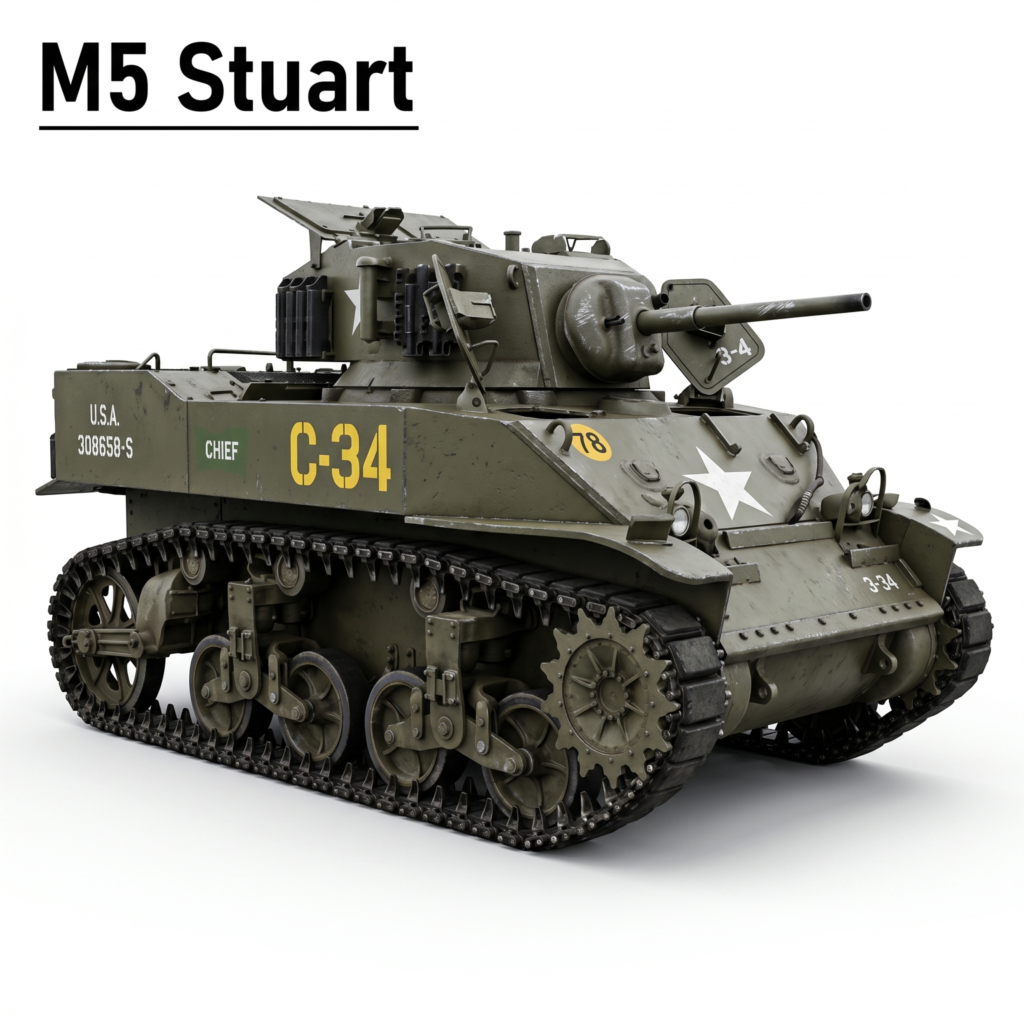
2. M5 Stuart — Improved Light Tank
In Service: 1942–1945
Total Produced: 8,884
History and Development
By 1941, the Continental W-670 aircraft engine used in the M3 Stuart was in high demand across multiple aircraft programs. Engineers redesigned the Stuart around twin Cadillac V8 automobile engines coupled to a Hydra-Matic automatic transmission — making the M5 one of the first tanks in the world with an automatic gearbox.
The result was a smoother, quieter, and more driver-friendly tank that retained the same turret and armament as the M3 while gaining a redesigned hull with better sloped armor.
Combat History
The M5 entered service in North Africa in 1942 and quickly became the standard US light tank in both Europe and the Pacific. By 1944, with the M24 Chaffee entering production, the M5 was being phased out of frontline service but remained active until the end of the war.
During the Battle of the Bulge, M5 Stuarts of the 740th Tank Battalion were among the few armored vehicles available to plug gaps in the American lines before Patton’s relief force arrived.
Specifications
| Specification | Details |
|---|---|
| Weight | 15.2 tons |
| Crew | 4 |
| Main Gun | 37mm M6 gun |
| Engine | Twin Cadillac Series 42 V8, 220 hp total |
| Top Speed | 36 mph (58 km/h) |
| Range | 100 miles (161 km) on road |
| Armor (max) | 67 mm |
Strengths and Weaknesses
Strengths: More refined than M3; automatic transmission reduced driver fatigue; better fuel efficiency; quieter engine.
Weaknesses: Same outdated 37mm gun; by 1944 clearly obsolete as a frontline tank.
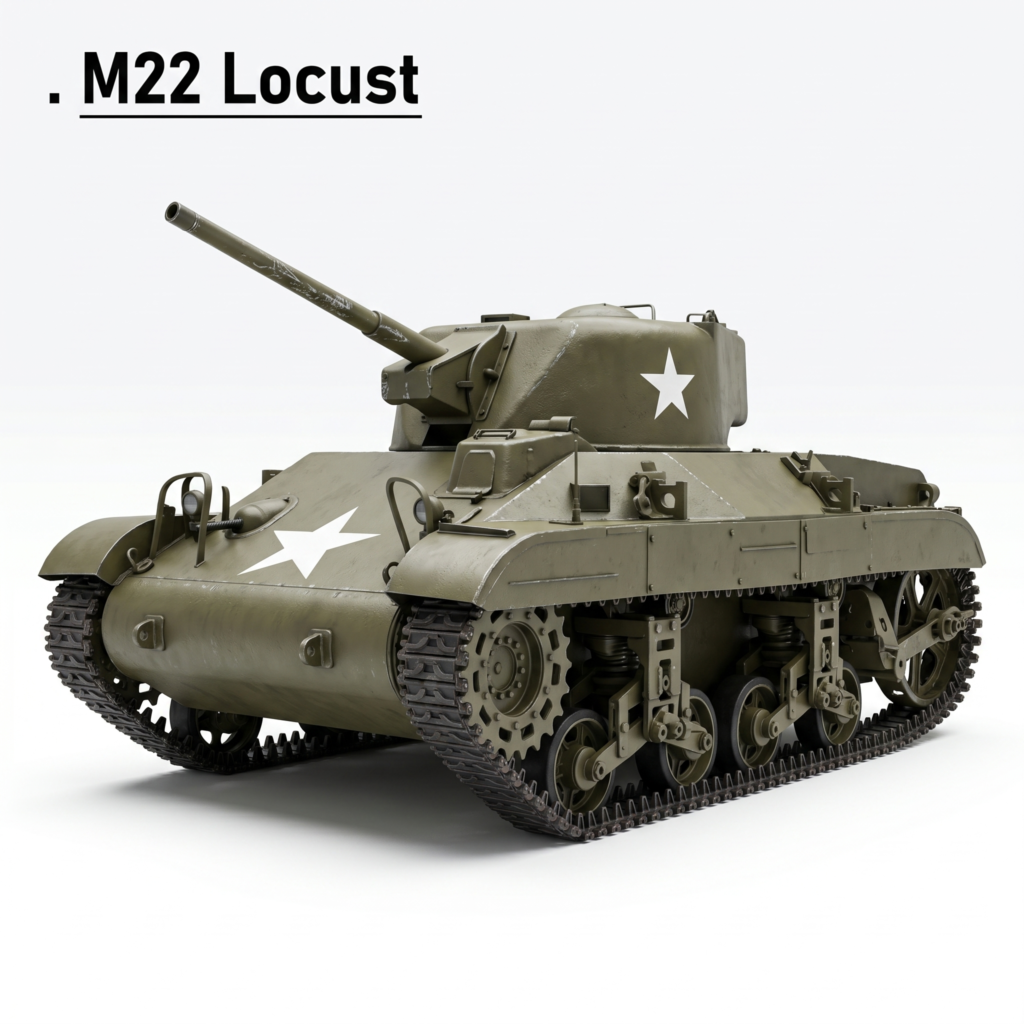
3. M22 Locust — Airborne Light Tank
In Service: 1944–1945
Total Produced: 830
History and Development
The M22 Locust was purpose-built for one of the most ambitious ideas of WW2: delivering tanks by glider directly onto the battlefield. Designed to fit inside the massive WACO CG-4A or British Hamilcar gliders, the Locust was stripped down to the bare minimum — so light that it sacrificed nearly all protection and firepower to achieve its glider-transport requirements.
Combat History
The M22 saw its only significant combat use during Operation Varsity in March 1945 — the Allied airborne crossing of the Rhine River. British 6th Airborne Division used Locusts carried in Hamilcar gliders. While the operation was successful, the Locust’s thin armor made it extremely vulnerable once on the ground.
US forces rarely deployed the M22 in combat, finding that it offered too little capability for the logistical complexity of airborne tank delivery.
Specifications
| Specification | Details |
|---|---|
| Weight | 7.4 tons |
| Crew | 3 |
| Main Gun | 37mm M6 gun |
| Engine | Lycoming O-435T, 162 hp |
| Top Speed | 40 mph (64 km/h) |
| Armor (max) | 25 mm |
Strengths and Weaknesses
Strengths: Light enough for glider transport; fast; simple to operate.
Weaknesses: Extremely thin armor; weak gun; practically obsolete the moment it entered service; vulnerable to almost all anti-tank weapons including infantry rifles at close range.
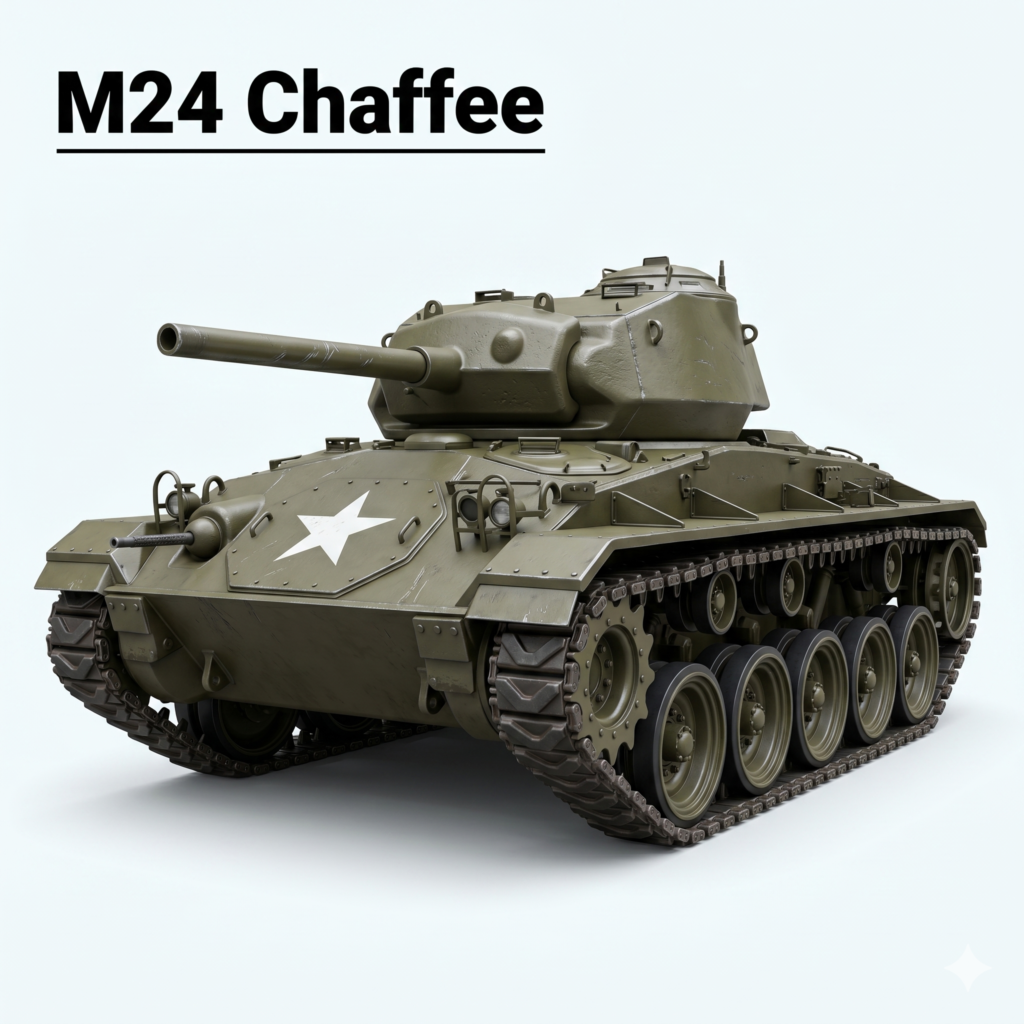
4. M24 Chaffee — Late-War Light Tank
In Service: 1944–1945
Total Produced: 4,731
History and Development
By 1943, the Stuart’s 37mm gun was clearly inadequate for modern warfare. The Army issued a requirement for a new light tank armed with a 75mm gun — the same weapon fitted to the early M4 Sherman. Engineers at Cadillac designed an entirely new hull around the lightweight 75mm T13E1 gun, producing a vehicle that finally gave American light tanks real anti-tank capability.
The M24 was named after General Adna Chaffee Jr., considered the father of the US Armored Force.
Combat History
The Chaffee arrived in Europe in late 1944 and immediately impressed crews with its firepower and handling. During the Battle of the Bulge in December 1944, Chaffees performed reconnaissance and flank security for heavier Sherman units.
In the Pacific, the Chaffee arrived just as the war ended but would go on to see extensive service in Korea and numerous post-war conflicts, proving the excellence of its basic design.
Specifications
| Specification | Details |
|---|---|
| Weight | 20.2 tons |
| Crew | 5 |
| Main Gun | 75mm M6 gun |
| Engine | Twin Cadillac Series 44T24 V8, 220 hp |
| Top Speed | 35 mph (56 km/h) |
| Range | 100 miles (161 km) |
| Armor (max) | 38 mm |
Strengths and Weaknesses
Strengths: Excellent 75mm gun for a light tank; good speed and maneuverability; comfortable for crew; smooth automatic transmission.
Weaknesses: Arrived too late to see widespread WW2 combat; armor still thin by 1944 standards.
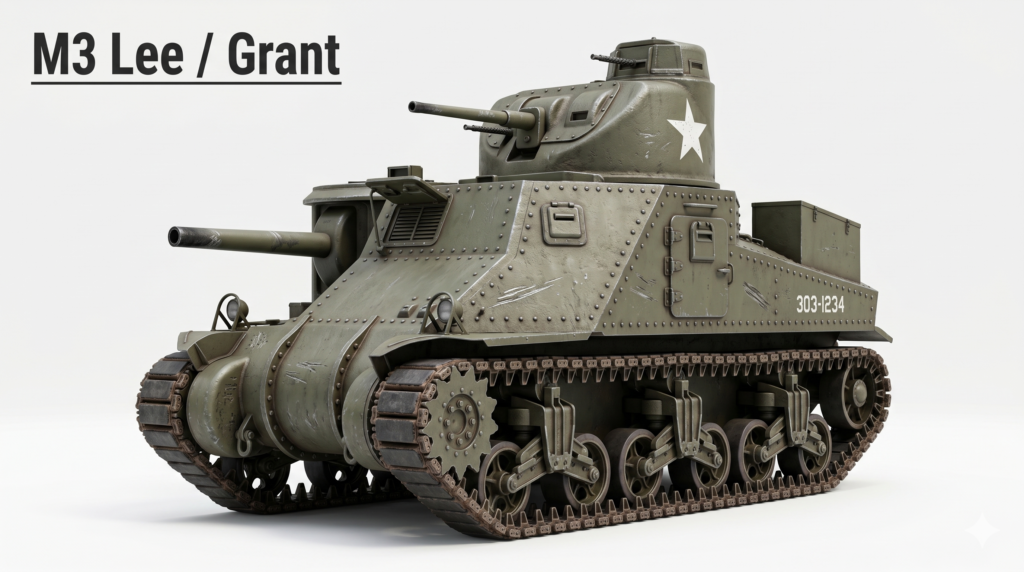
5. M3 Lee / Grant — Early Medium Tank
In Service: 1941–1945
Also Known As: “Lee” (US version), “Grant” (British version with modified turret)
Total Produced: 6,258
History and Development
The M3 medium tank was born out of crisis. In 1940, after watching German panzers demolish Allied armor in France, the US Army urgently needed a medium tank armed with a 75mm gun. The problem: no one had yet built a turret ring large enough to mount a 75mm gun in a full rotating turret on an existing hull.
The solution was unorthodox. Engineers mounted the 75mm gun in a sponson on the right side of the hull — a fixed mount that could only traverse 15 degrees — while a smaller turret on top carried a 37mm gun. It was an awkward design, but it put a powerful weapon into action quickly.
Combat History
The M3 Lee/Grant arrived in North Africa in 1942, giving Allied forces their first tank capable of engaging German armor at a distance. British Grant crews famously said the tank “gave them a weapon to fight with at last.”
In the battles around Gazala and Tobruk in 1942, the Grant’s 75mm gun could knock out most German tanks, although the tank’s tall silhouette and fixed hull gun made it tactically awkward.
American Lee tanks fought in the opening US armored engagements at Kasserine Pass in February 1943. Despite a harsh debut against experienced German forces, the experience provided crucial lessons that shaped US armored tactics going forward.
In the Pacific and on the Soviet Eastern Front (through Lend-Lease), the M3 served until the end of the war.
Specifications
| Specification | Details |
|---|---|
| Weight | 30 tons |
| Length | 18 ft 6 in (5.64 m) |
| Crew | 6–7 |
| Main Gun | 75mm M2/M3 (hull), 37mm M6 (turret) |
| Engine | Continental R-975 radial, 340 hp |
| Top Speed | 26 mph (42 km/h) |
| Range | 120 miles (193 km) |
| Armor (max) | 57 mm |
Strengths and Weaknesses
Strengths: Powerful 75mm gun came into service quickly; reliable engine; good for its time in 1941–42.
Weaknesses: Very tall silhouette (easy to spot and hit); hull-mounted gun had very limited traverse; quickly superseded by the M4 Sherman.
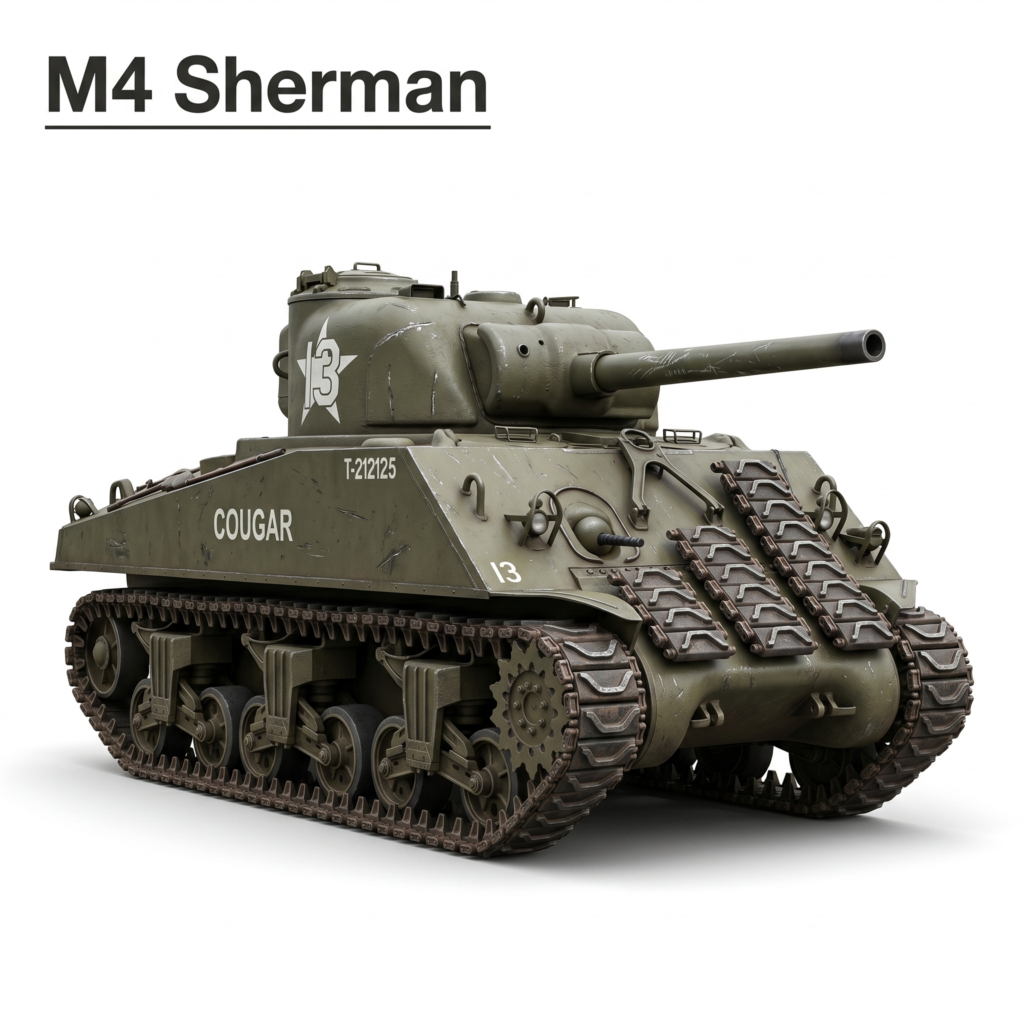
6. M4 Sherman — The Workhorse of Allied Victory
In Service: 1942–1945
Total Produced: 49,234 (all variants combined)
Named After: General William Tecumseh Sherman
History and Development
The M4 Sherman is the most important American tank of World War 2 and arguably the most significant Allied tank of the entire conflict. Designed to replace the flawed M3 Lee, the Sherman finally put the 75mm gun in a fully rotating turret on a reliable, mass-produceable chassis.
Development began in early 1941. By September 1941, the design was approved, and by February 1942, the first production M4s were rolling off the line at the Lima Locomotive Works in Ohio. American industry would go on to produce nearly 50,000 Shermans — a manufacturing feat that overwhelmed the enemy through sheer numbers.
Major Variants
The Sherman was produced in more variants than almost any other WW2 tank:
M4 — Original production model with welded hull and Continental radial engine.
M4A1 — Cast rounded hull (instead of welded); the first variant to see combat at El Alamein in October 1942.
M4A2 — Twin GM diesel engines; primarily supplied to Soviet Union and Marine Corps.
M4A3 — Ford GAA V8 gasoline engine; considered the best Sherman engine. Became the preferred US Army variant from 1944 onward.
M4A4 — Chrysler A57 multibank engine (five car engines combined); primarily supplied to British forces.
M4(76)W — Upgraded with a high-velocity 76mm gun to combat heavier German tanks like the Panther and Tiger.
M4A3E8 “Easy Eight” — Upgraded suspension (HVSS), wider tracks, and 76mm gun; the finest Sherman variant of the war.
M4A3E2 “Jumbo” — Assault tank with 100mm of frontal armor; used for leading assaults on fortified positions.
Firefly — British modification with 17-pounder (76.2mm) high-velocity gun; the only Allied tank that could reliably destroy Tigers at normal combat range.
Combat History
The Sherman’s combat debut came at the Second Battle of El Alamein in October 1942, where British M4A1s helped drive Rommel’s Afrika Korps out of Egypt. American Shermans first saw action in Operation Torch (North Africa landings) in November 1942.
In the Italian Campaign (1943–45), Shermans struggled in the narrow mountain roads and bocage-like terrain, but their reliability kept them moving when German tanks were constantly breaking down.
On D-Day, June 6, 1944, specially waterproofed Duplex Drive (DD) Shermans were supposed to swim ashore at Omaha and Utah beaches ahead of the infantry. Rough seas sank most at Omaha with tragic results; those at Utah fared better. The lesson shaped how armor was employed in subsequent amphibious operations.
During Operation Cobra and the breakout from Normandy (July–August 1944), Patton’s Third Army drove hundreds of miles across France in weeks — a campaign only possible because of the Sherman’s mechanical reliability. German tanks were more powerful individually, but they broke down constantly; Shermans kept rolling.
The Battle of the Bulge in December 1944 tested the Sherman severely against massed German armor. The 76mm Sherman proved capable of handling Panthers in favorable conditions, though Tiger IIs remained a serious threat at any range.
By the war’s end, Shermans had fought from the beaches of North Africa to the heart of Berlin (in Soviet hands), from Pacific atolls to the Philippines. No single tank saw wider service.
The Sherman Controversy
The Sherman has long been criticized — especially compared to the German Panther and Tiger. It’s true that a Sherman needed favorable positioning or multiple shots to defeat a Tiger, while one Tiger shot could destroy a Sherman from the front. German crews called them “Tommy Cookers” and Americans bitterly called them “Ronsons” (a lighter brand that promised to light first time).
However, historians increasingly argue that the Sherman was the right tank for American strategy. It could be produced by the thousands in American factories, shipped across oceans, maintained by minimally trained mechanics, and kept running for thousands of miles. Germany’s superior tanks were produced in small numbers, broke down frequently, and couldn’t be replaced fast enough to matter.
Specifications (M4A3, most common US variant)
| Specification | Details |
|---|---|
| Weight | 33.65 tons |
| Length | 19 ft 2 in (5.84 m) |
| Width | 8 ft 7 in (2.62 m) |
| Height | 9 ft (2.74 m) |
| Crew | 5 |
| Main Gun | 75mm M3 (or 76mm M1A2 in later variants) |
| Secondary | 2 × .30 cal Browning, 1 × .50 cal Browning |
| Engine | Ford GAA V8, 500 hp |
| Top Speed | 30 mph (48 km/h) on road |
| Range | 120 miles (193 km) |
| Armor (max) | 76 mm frontal (100 mm on M4A3E2 Jumbo) |
Strengths and Weaknesses
Strengths: Extremely reliable; easy to maintain and repair; mass-produced in enormous quantities; comfortable for crew; excellent gun depression for hull-down fighting; adaptable to countless variants and modifications.
Weaknesses: Outgunned and out-armored by German Panther and Tiger tanks in direct frontal engagement; early models prone to catastrophic fires when ammunition cooked off (partially solved by wet stowage in later variants).
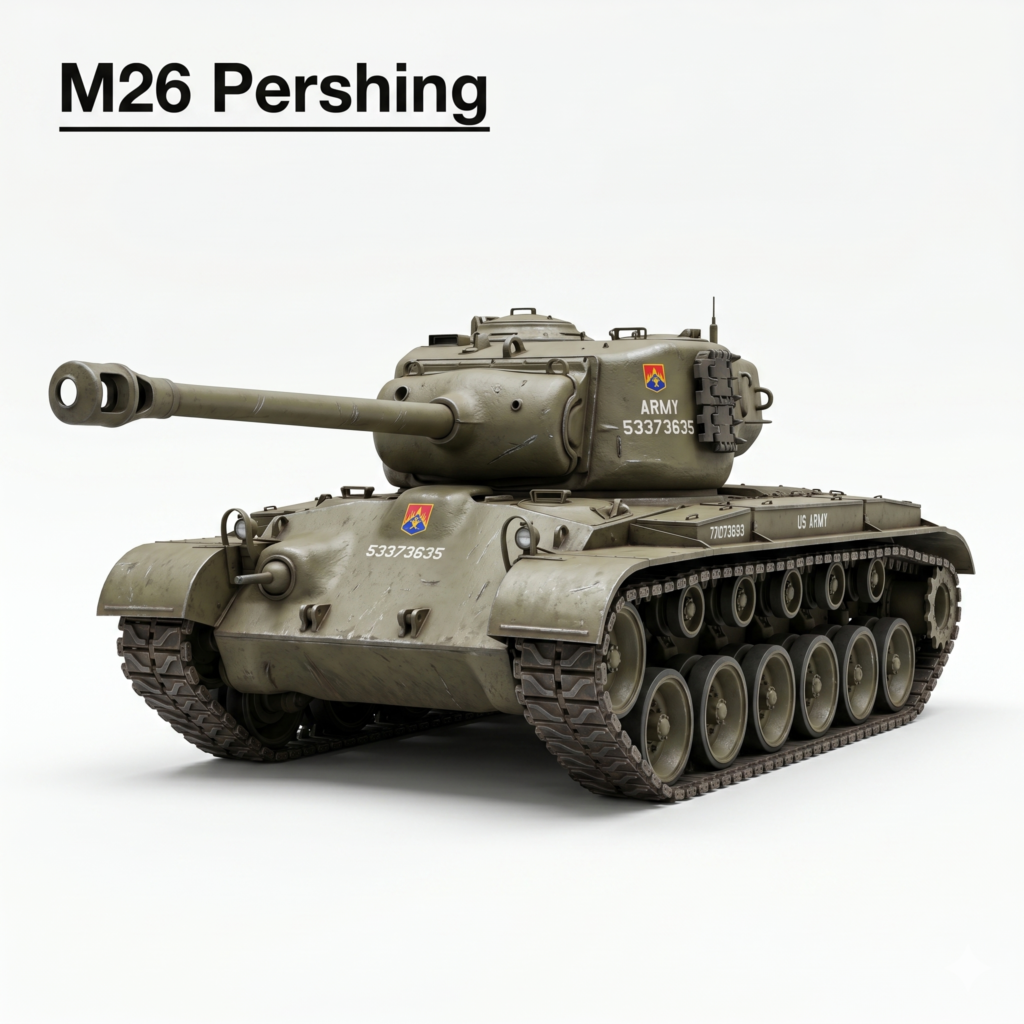
7. M26 Pershing — America’s Heavy Tank
In Service: 1945
Total Produced: 2,212
Named After: General John “Black Jack” Pershing
History and Development
The M26 Pershing was America’s answer to the German Panther and Tiger — a true heavy tank with thick armor and a powerful 90mm gun. Development began as early as 1942, but Army commanders who believed the Sherman was adequate delayed its fielding for over two years.
By late 1944, after heavy Sherman losses in Normandy, the pressure to field a better tank became irresistible. The M26 was rushed into production and the first units shipped to Europe in January 1945.
Combat History
The M26 Pershing had a limited but impressive combat debut. Just 20 Pershings were deployed to Europe by early February 1945. On February 26, 1945, a Pershing crew achieved what became the most famous US tank engagement of the war: Sergeant Bob Earley’s Pershing knocked out a German Panther in a close-range street fight in Cologne, Germany — the engagement was captured on film and became iconic footage.
In the battles pushing through Germany in March–April 1945, Pershings proved capable of defeating Panthers and even Tiger I tanks at combat ranges. However, the tank arrived too late and in too few numbers to significantly influence the war’s outcome.
The M26 went on to serve as America’s main battle tank in the Korean War.
Specifications
| Specification | Details |
|---|---|
| Weight | 46 tons |
| Length | 28 ft 4 in (8.65 m) with gun |
| Crew | 5 |
| Main Gun | 90mm M3 gun |
| Engine | Ford GAA V8, 500 hp |
| Top Speed | 25 mph (40 km/h) |
| Range | 92 miles (148 km) |
| Armor (max) | 102 mm frontal |
Strengths and Weaknesses
Strengths: 90mm gun could penetrate any German tank; thick frontal armor; finally gave US tankers a vehicle that could fight Germans on equal terms.
Weaknesses: Arrived too late to make a major impact; underpowered engine for its weight; slower than the Sherman.
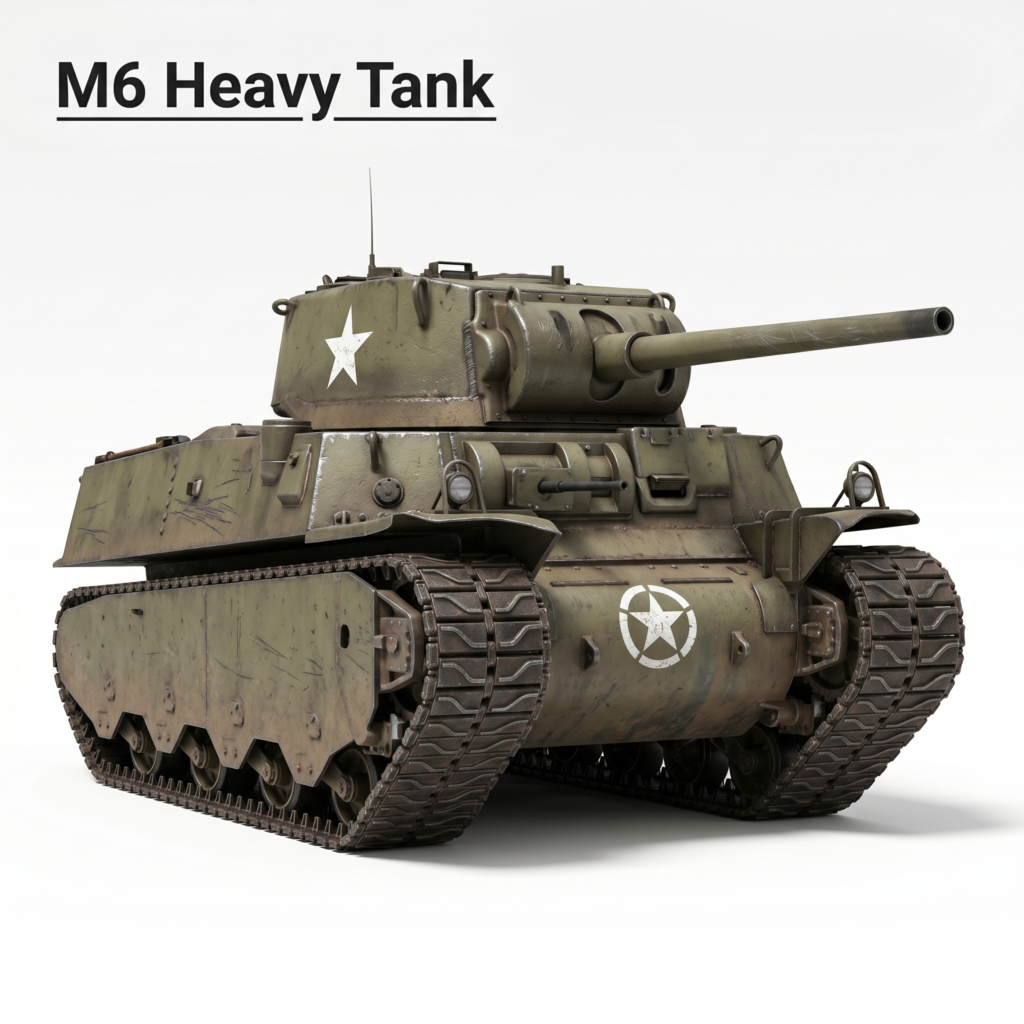
8. M6 Heavy Tank
In Service: Produced but not deployed in combat
Total Produced: 40
History and Development
The M6 was America’s attempt at a true superheavy tank in 1940–41, weighing nearly 60 tons and armed with a 76mm gun and a coaxial 37mm gun. It was one of the largest and heaviest tanks designed by any nation at the time.
Despite being ready for production by 1942, Army General Lesley McNair decided it was too heavy to ship overseas and too large to operate effectively in the terrain where US forces were fighting. Only 40 were built before the program was cancelled.
The M6 never fired a shot in anger. It represents one of the great “what-ifs” of US armored development — a tank that might have dramatically changed early engagements in North Africa or Italy, had the Army chosen to deploy it.
Specifications
| Specification | Details |
|---|---|
| Weight | 57.4 tons |
| Crew | 6 |
| Main Gun | 76mm M7 gun |
| Secondary Gun | 37mm M4 gun (coaxial) |
| Engine | Wright G-200 radial, 960 hp |
| Top Speed | 22 mph (35 km/h) |
| Armor (max) | 83 mm |
US WW2 Tank Comparison Table
| Tank | Type | Weight | Main Gun | Top Speed | Crew | Total Built |
|---|---|---|---|---|---|---|
| M3 Stuart | Light | 14.7 t | 37mm | 36 mph | 4 | 13,859 |
| M5 Stuart | Light | 15.2 t | 37mm | 36 mph | 4 | 8,884 |
| M22 Locust | Light/Airborne | 7.4 t | 37mm | 40 mph | 3 | 830 |
| M24 Chaffee | Light | 20.2 t | 75mm | 35 mph | 5 | 4,731 |
| M3 Lee/Grant | Medium | 30 t | 75mm + 37mm | 26 mph | 6–7 | 6,258 |
| M4 Sherman | Medium | 33.6 t | 75mm / 76mm | 30 mph | 5 | 49,234 |
| M26 Pershing | Heavy | 46 t | 90mm | 25 mph | 5 | 2,212 |
| M6 Heavy | Heavy | 57.4 t | 76mm | 22 mph | 6 | 40 |
Frequently Asked Questions
What was the most produced US tank of WW2? The M4 Sherman, with approximately 49,234 units produced across all variants. It remains one of the most produced tanks in history.
What was the best US tank of WW2? Most historians consider the M4A3E8 “Easy Eight” Sherman the best all-around American tank of the war — balancing firepower, protection, reliability, and availability. The M26 Pershing was technically superior but arrived too late.
Could the Sherman defeat a Tiger tank? A standard 75mm Sherman could not reliably penetrate a Tiger I frontally at normal combat distances. However, the 76mm Sherman could penetrate a Tiger’s side and rear armor, and the British Firefly (17-pounder Sherman) could defeat a Tiger from the front. Flanking tactics, numerical superiority, and artillery support were the standard solutions.
How many US tanks were destroyed in WW2? Exact figures vary, but approximately 4,000–7,000 American tanks were destroyed or permanently disabled in combat across all theaters of WW2.
What tank did the US Army use most in the Pacific? The M4 Sherman was the primary US tank in the Pacific from 1943 onward, though M3 Stuarts were used heavily in the early island campaigns. Against Japanese armor, even the 37mm Stuart was often more than adequate.
Was the M26 Pershing better than the German Tiger? The M26 Pershing was broadly comparable to the Tiger I in terms of protection and firepower. Its 90mm gun could penetrate the Tiger’s frontal armor, and the Tiger’s 88mm gun could penetrate the Pershing’s frontal armor in return. Many historians consider the M26 slightly superior overall due to better reliability and maneuverability.
Conclusion
The story of American tanks in World War 2 is ultimately a story of industrial might overcoming tactical limitations. While no American tank in 1941–44 could individually match the best German designs on a one-to-one basis, the United States produced them in overwhelming numbers, kept them running in every climate and terrain on earth, and continuously improved them based on combat feedback.
The M4 Sherman — maligned in some accounts, celebrated in others — remains the symbol of that strategy. Imperfect, sometimes outmatched, but always present, always running, and always arriving in numbers that no enemy could counter.
By May 1945, American tanks had rolled from the beaches of North Africa to the Elbe River, from the jungles of New Guinea to the streets of Manila. The tanks that made it possible were not always the best in the world — but they were, without question, good enough to win.